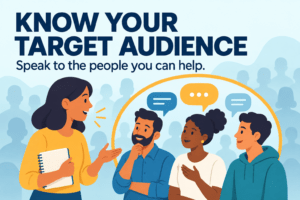

Someone can recognise a business name without knowing what the business offers. These six checks help you explain the work, who it is for and how an interested person can find out more. You can use the fictional examples to learn before you have a business, website or customers.
In this article, your audience means the people you want to reach. Your brand is the name, appearance and behaviour by which people recognise your business. Familiarity with a brand does not prove that its work is reliable.
1. Describe the work and who it is for
Fictional example: “Saturday sewing lessons for adults who have never used a sewing machine. Practise threading and stitching on a machine provided in the class.” The reader can identify the activity, starting level and equipment available.
“Sewing lessons” is a useful short label, but it leaves those details unanswered. If you publish a real class notice, add its price, place, dates and how to book. Check each detail before making it a promise. For an idea you have not arranged yet, label it as a plan and say which details are undecided.
2. Choose a place where the information is relevant
Suppose the fictional class organiser wants to share a notice. A community noticeboard could be relevant if people use it to find local classes. An online group could be relevant if its members ask about learning to sew and its rules allow class notices.
Those are possibilities to investigate, not proof that either place will bring bookings. Read the rules and ask the organiser or group administrator before posting where permission is needed. You do not need to join every social website. Choose a place you can keep up to date.
3. Tell a true story that explains a choice
A useful story explains why someone does the work in a particular way. Fictional illustration: a sewing teacher remembers having to borrow a machine when learning, so now provides machines during classes. The story explains the decision to provide equipment; it does not prove the quality of the teaching.
If you tell your own story, use an experience that happened and only the personal details you want to share. Do not invent an origin story because it sounds appealing. The illustration below shows a beginning, a design and a finished object: the connection between those stages is what a useful story explains.

4. Explain something people can use without buying
The fictional sewing teacher could publish instructions for threading the model of machine used in class, with a clear picture of each step. That would help a learner check where the thread goes. A general promise to “help you sew better” would not supply those instructions.
Choose something you know how to explain accurately. Someone who reads free help should gain useful understanding even if they never book. When you are still learning, it is reasonable to study examples before offering advice yourself.
5. Make shared work clear
If the teacher and a community centre organise a class together, the notice should say who teaches, who takes bookings and whom to contact about a cancellation. Otherwise a reader may not know which person can answer their question.
Only describe an arrangement that both sides have agreed. If someone is paid to recommend the class, explain that connection beside the recommendation so readers can take it into account.
6. Check what a reader understood
To practise without a business, show someone the fictional description in section 1 and ask what the lesson teaches, who it is for and whether a machine is provided. Let them answer before explaining what you intended.
Compare their answers with the description. If an answer reveals a missing or confusing detail, revise that sentence and ask again. One reader can reveal a misunderstanding; their answer does not show what everyone understands or whether anyone will buy.